Posts

Book launch and talks in four months

Image
 As I wrote in Critical Data Storytelling for Libraries : " There is no greater indication that libraries have a role to play in a free society than the degree to which they are attacked by authoritarian leaders and pro-censorship groups." Among the indications that the ideas in the book are timely have been the number of invited talks during fall 2025, and the number that I'm having to turn down. I was able to accept thirteen (13) invitations from August to November. The largest attended one was the AISLE keynote for Illinois school librarians. The one that most fueled my own creative thoughts was United for Libraries, the ALA-based group focusing on how trustees and friends of the library can help, because I have great interest in how data storytelling for libraries can have real local influence through those best positioned to retell the stories. The furthest away one was in Denmark, where I was so fortunate to spend my sabbatical and was already traveling there for my...

Critical Data Storytelling for Libraries: : Crafting Ethical Narratives for Advocacy and Impact

Image
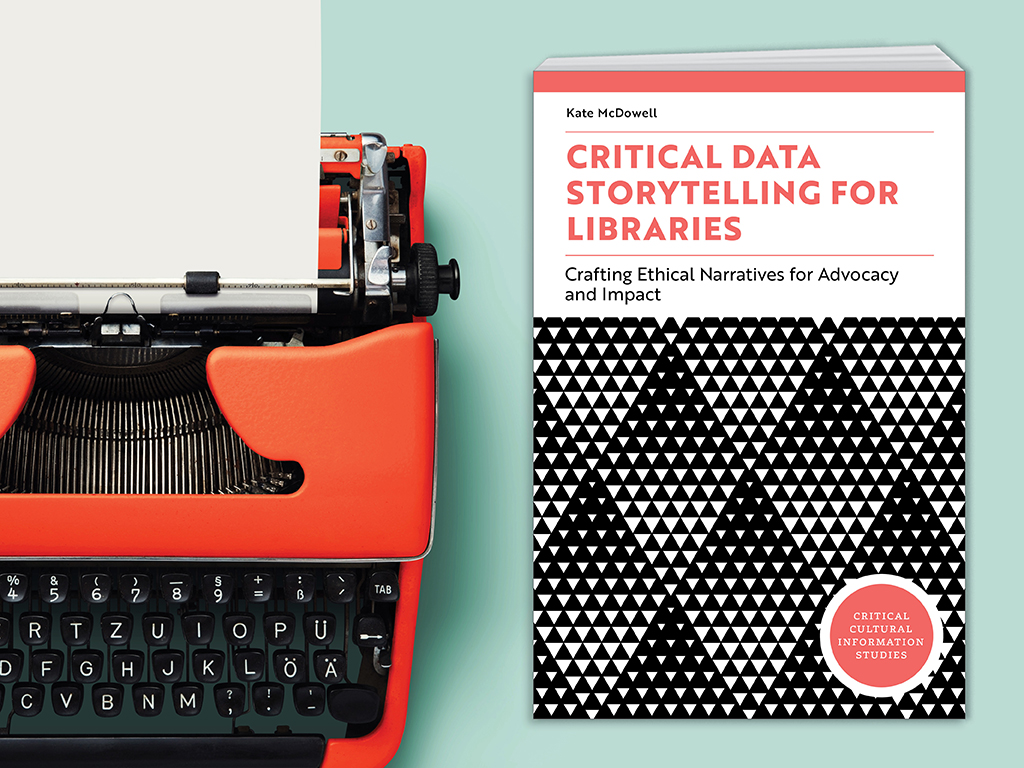
After several years of writing, with help from many colleagues along the way, my new book is  coming out this month!  I wrote this book because library workers who collect data are often siloed from those who tell stories. This book speaks to both audiences—data and story experts—to tackle common obstacles mindfully, with awareness of power and who has been historically excluded. I’ve based it on my 30 years of library work as well as my workshops and consulting, through which I frequently working struggling librarians to tell better data stories. T his book brings together current, critical insights for using data ethically for library advocacy, social justice, and inclusivity.   Sadly, rising pro-censorship movements and shrinking budgets threaten institutions like libraries, where anyone can walk in the door without having to believe or buy anything. We are seeing active defunding of libraries at every political level in our society today, federal to local. Trag...

Look for the Helpers: Appreciating the DSTL Students

Image
  When Mr. Rogers was just a boy named Fred, his mother advised him, in times of trouble, that he should "Look for the helpers. You will always find people who are helping." He repeated that wisdom often. Our research team has been very fortunate to have seen some remarkable helpers over the past four years. This post is dedicated to all of the students who have helped to build the  The Data Storytelling Toolkit for Libraries (DSTL). The DSTL will continue, despite funding uncertainties (see below), but the work will necessarily have to take new forms. So it's a perfect time to pause and say thank you to the helpers , specifically the student workers and practicum participants from 2021-2025. On behalf of co-PIs Matt Turk and Jill Naiman, collaborators Sara Goek from the Public Library Association and Martha Kyrillidou of Quality Metrics LLC , and myself, we wish to give our heartfelt thanks to all of the following students: Research Assistants:   Xinhui Hu (2021-25)...

Data Storytelling for Librarians, Augusta Baker Series 2023

Image
  I was so honored this week to give a lecture on Data Storytelling for Librarians as part of the Augusta Baker Lecture Series, organized and led by Dr. Nicole Cooke at the University of South Carolina. It was a talk to support library advocacy with data. You can learn more about this talk and the whole series here: https://sites.google.com/view/bakerlectures/baker-diversity-series/dr-kate-mcdowell The main Augusta Baker lecture is today, don't miss it!

Bad Information: What's wrong with the story?

New article in Information Matters is out! Here's a brief excerpt: "We all love a good story, and storytelling is a central way that human share experiences, from what happened at work or school today to the most meaningful moments of our lives. We tell stories about everything, from what we know to be true to what we fear might happen someday, and stories always involve emotional engagement. How do we know if a story is accurate or inaccurate, rational or exaggerated, correct or misleading, especially when an untrue story may be more gripping than the truth? When misinformation is spreading as people retell fake stories, stopping it requires a better understanding of how stories work and what specific information errors lead to the crafting—deliberate or accidental—of compelling misinformation stories."  https://informationmatters.org/2023/04/storytelling-dynamics-and-misinformation-the-bad-s-dikw-framework/

ALA and the Data Storytelling Toolkit for Librarians

Image
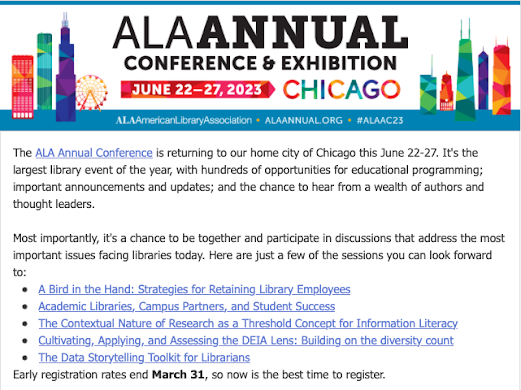
So ALA sent out their email to invite members to come to ALA Annual in Chicago this year, and they selected five sessions to highlight. Ours is one of them!   As the US struggles with an onslaught of book banning like we have not seen in my lifetime, our project, the Data Storytelling Toolkit for Librarians , aims to get ahead of what we expect to come next: local battles over the existence of public and community college libraries. In fact, this battle has already begun, with some community college libraries in my state losing up to 2/3rds of their former staffing levels since the Covid-19 pandemic. We are right on time. This concern about defending libraries launched my research on understanding data storytelling in librarianship, with a pilot project in 2019 funded by the Center for Social & Behavioral Science at the University of Illinois--an article on obstacles to library data storytelling is in press with Public Library Quarterly, likely to be published in summer 2023. ...

AIVCA, the Anti-Infodemic Virtual Center for the Americas

  New article out today! Grateful to share the development of this Anti-Infodemic Virtual Center with Ian Brooks at the Center for Health Informatics. DOI https://doi.org/10.26633/RPSP.2023.5 After a two-hour WHO workshop on how to understand and use storytelling today, I'm reminded again of how much colleagues have helped support my well being simply by sharing the work of try to establish stories based on accurate data and information. The workshop was led by a UK organization focusing on qualitative research, and it was based on 68 interviews with frontlines health care providers about storytelling in their word during the Covid-19 pandemic and accompanying infodemic. The infodemic is the accompanying disinformation, misinformation, malinformation, and flood of information that accompanies major disruptive events in a digitally networked world. Here's the WHO overview of the topic . For my part, colleagues like these were an absolutely foundational part of my sustaining not ...

Data Storytelling Toolkit for Librarians, early demo!

 Data Storytelling Toolkit for Librarians, early demo is available! This is more of a conceptual mapping than a completed product or project, in alignment with our two-year planning grant. But you can walk through a demo mockup here: https://uiucdstl.wixsite.com/uiucdstl This work is a product of a year of collaboration with the Core Design Team, a team of 40 volunteer librarians, library data experts, and researchers who have contributed their knowledge and experience throughout this first year of the project. Next year, we'll be refining the toolkit and offering larger public workshops for broad participation and feedback from the library community. Stay tuned!

Data Storytelling for Librarians and the Data Storytelling Toolkit

 This fall, with Dr. Matt Turk and RA Xinhui Hu, we launched the Data Storytelling Toolkit for Librarians project ( https://imls.gov/grants/awarded/re-250094-ols-21 ) with a free webinar on 9/30 (recording publicly available at  https://mediaspace.illinois.edu/media/t/1_69ag1gj0 ) and 675 registrants!  The Data Storytelling Toolkit for Librarians (DSTL project website:  https://uiucdstl.wixsite.com/uiucdstl ) will connect real-world examples of data use with data stories (including narrative strategies and data visualizations) as adaptable templates for communicating and related online free resources for data exploration and visualization. The long-term vision is to cultivating data storytelling expertise as a signature expertise of our field, so that when communities have data storytelling needs, they are met at libraries and by librarians. As of 11/15/22, we have collected 11 data use scenarios, which we're now calling "common storytelling needs." The goal is to de...

Storytelling as Information

We have loads of theories about the production of misinformation that focus on those generating it (manipulators, liars, propagandists), but so little that centers the audience. Such an exploration would point us toward its voluntary rapid circulation and the collective behaviors of sharing. The closest thing we've got is storytelling in terms of how gossip and rumors blaze across communities, now and historically. But of course the spread of stories, true or false, is enabled by the internet and platforms for information sharing that amplify polarizing information. A key model for qualitative research in these areas is storytelling, but until recently storytelling has been more practice than theory in library and information science (LIS) and the information sciences (IS). So I'm working on theorizing storytelling as information for multiple reasons, and the rapid spread of misinformation is one of them. Another is that indigenous knowledge is routinely shut out of (settler co...

Slow Fear, a Saturday Story

Today's Saturday story comes from my listening to many friends who are talking about not wanting to be afraid right now, and it features a postcard from The Courage Connection, an organization headed by my friend Elizabeth McGreal Cook who helps people survive domestic abuse.

Being Calm, a new Saturday Story

I took a couple of weeks off, but I'm back with a new Saturday Story, this one all about a story I heard this week about what staying calm can do and how it can be a gift for others. The talk I mention can be found here: https://www.awakin.org/calls/470/parker-palmer-with-mary-pipher-and-michael-penn/

Waiting

Here's this week's flawed, weird, but heartfelt video offering to my friends.

Digging Deep (Storytelling to Sustain Us)

Digging Deep It's gardening time and covid-19 time, all at once. Today the winds are a constant whistle and howl here in the flat midwest, though yesterday it was warm and rainy. March is going out like a lion. This week, I came as I was. In the previous videos I had dressed up more or less as I would be for teaching. But, with so many home and emotionally exhausted, it felt more authentic to show up in my gardening clothes, clean faced, just to have a conversation. After all, this is for my friends as an audience, and they don't mind. Audience matters here. Though I've set these for public viewing in the thought that they might bring comfort to others, I mean this to be for those who have been friend enough to me to stay on Facebook. It's a wide swath of people from all across my life, family and childhood all the way to professional connections from this year. I had some requests to move the time for the West Coast folks, but in truth my energy is limited to...

Storytelling to Sustain Us

Here we are in March 2020, and if we had told ourselves that we'd be sheltering in place and wondering how to get to the grocery store a month ago, we would have looked at ourselves very oddly. And yet here we are. I've been trying some experiments with live video on facebook. It started this last weekend, when I couldn't sleep on Friday night. I just kept thinking about how much we need to spread the word about these brand new unfamiliar CDC safety protocols (trying not to catch the covid-19 virus, who is most vulnerable, how to wash our hands). And how, in most of human history, we spread the word just by telling each other. Some people just need to hear things from a friend. The first one was about reading the CDC guidelines, and being caring to each other and gentle with ourselves. I thought I might call it "Heard it From a Friend": The second one probably jammed too much in, but it was about soap, videos, people we know, and tenderness, and now I'...

Understanding Helpers: from folklore to nonprofits

Before you can defeat a dragon, you need some help. Everyone seems to understand the idea of the helper in a narrative as a figure that the hero encounters on their journey. The helper helps the hero, sometimes through an outright gift but, often, as a reward for some relatively small kindness that the hero rendered to the helper well before the hero knew that this figure might offer such rewards. But how much do we ever really know about the helper? And how might that relate to the helping work of nonprofit organizations? Take the Russian tale of  Vasilisa . At the house of the evil witch Baba Yaga, Vasilisa is kind to the hungry cat, so the cat gives her a ribbon and a comb. When she is making her escape from the witch, she throws the ribbon behind her and it turns into a river, then she throws the comb behind and it turns into a thick forest. Vasilisa had her instructions to throw the ribbon and comb behind her, but she did not have any way of knowing that ...