Posts

Showing posts with the label Reading Around Race

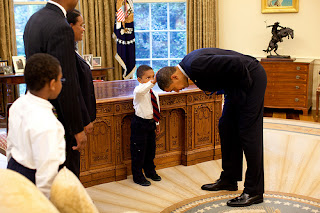
Obama's haircut

Image
http://www.flickr.com/photos/whitehouse/3532376714/in/photostream/ Children's books represent, but so do people, and this photo captures an amazing moment when a young boy asked President Obama " if the President's haircut felt like his own."   Obama responded by letting the boy feel his head for himself.

national book award

Loving the diversity of this honored group of authors! http://www.nationalbook.org/ I've just requested Inside Out and Back Again by Lai, the young people's winner, from the library.  That plus a few recent YA novel to come.

explicit instruction in the culture of power

Professor Emeritus Chip Bruce wrote/compilled the following graduate student survival guide awhile back, in 2008, but it's relevant again thanks to another engaging discussion at the Reading Around Race group today (Thanks to Sharon Irish for pointing Chip's blog post out to me!): http://chipbruce.wordpress.com/teaching/graduate-student-survival/ The discussion centered around two articles that I selected as early works of two major scholars on race and education, Lisa Delpit and Beverly Daniels Tatum.  Delpit in particular pointed out in her 1988 article in the Harvard Educational Review that there's a real need for direct instruction in how to engage with academic institutions as a student and attain the highest levels of success.  As she put it:   "If you are not already a participant in the culture of power, being told explicitly the rules of that   culture makes acquiring power easier."  When issues of race are at hand, it's worth remembering that ...

The First R

The First R:  How Children Learn Race and Racism by Debra Van Ausdale and Joe R. Feagin Ausdale and Feagin together do a nuanced job of analyzing interactions among young children related to racial identity, showing that children as young as three years old see how racism operates in their worlds.  They show how these children learn to avoid the topic of race around adults, just as adult avoid the topic around them.  And yet young children are willing and able to engage in discussions of race among themselves, as long as they are outside of the earshot of adult authorities.  They find that white children will be insistent about regulating how black children define themselves, looking at an example of an African-American girl who chose to represent her skin color with both brown and pink paint, which was met with vocal protest from several White girls.  The African-American girl, however, was painting an image of both sides of her hands, and so defied the typi...

CCB Brownbag Recap: Fantasy and Race

On Thursday 11/3, I gave a Brown Bag presentation on Fantasy and Race.  This interest stems from at least two directions.  One of those is the relative lack of authors of color writing fantasy literature for youth as well as character of color represented as more than tokens in fantasy and sci fi.  A big shout-out is in order here to the ways that former students have called that syllabus out for these big gaps. So I used the word "represented" above, and it the idea of "representation" that was key to my talk yesterday.  I take it as a given that youth advocates, librarians among them, want youth to know that they belong in all things literature, literacy, and library-related.  One way to assure this is to be sure that racially and ethnically diverse authors and characters are represented in library collections and if you're reading my blog at all you probably ascribe this notion as a fundamentally good idea in library services.  Of course there are limi...

reading in the thick of race

Our reading group, which I help to facilitative every other Friday, is called Reading Around Race.  The "around" here means mobility as opposed to stasis.  But, really, we don't go around any of it, we go through it all, as together as we can be given our different positions in society, life paths, and roles within the university that brings us together. This week, we read Honma's article "Trippin' Over the Color Line," which is a resounding critique of LIS as a discipline that doesn't acknowledge its own whiteness.  While I can pick at his conflation the academic side of LIS with the ALA (that demonstrate to me that his knowledge of the field is partial, though he is as well-informed critic as any field might hope to have), basically, his argument that silence around whiteness causes trouble in library and information science education and professional work is sound.  I think of the hundreds of local projects that contradict the overall characteri...